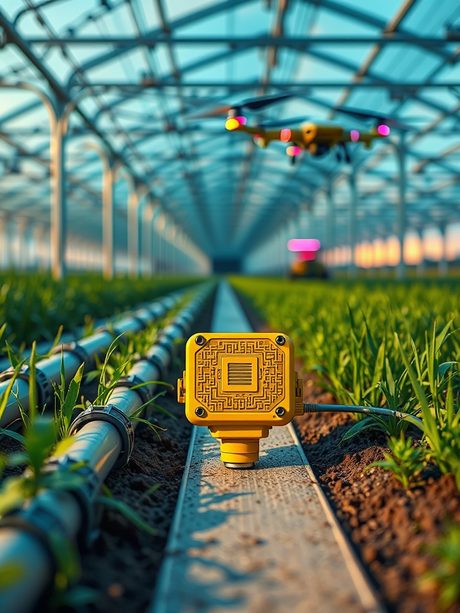
Purdue’s Exploratory Studies program, now in its third decade, has quietly incubated machine learning models that predict crop failure before it happens. Unlike short-lived innovation labs, this program has sustained interdisciplinary research across engineering, data science, and agriculture—buildi…
Xiaotang Lu’s NIH Director’s New Innovator Award—funding five years of high-risk neuroscience research—reveals a hidden blueprint: using AI to decode complex biological systems. Her work mapping neural connections with molecular precision mirrors the challenge of decoding plant-soil-climate interact…
The Morrow Plots at the University of Illinois Urbana-Champaign, the longest-running agricultural study in the U.S., are now being digitized to fuel next-gen AgTech AI. Their uninterrupted records—from 1876 to today—offer a rare longitudinal dataset that captures not just yields, but the full contex…
crop production support operations are concentrated in just three states — California, Texas, and Iowa. That’s not just a market insight — it’s a national infrastructure vulnerability. How does this concentration affect AI model training, resilience, and innovation across regions?…
for Farm Machinery and Equipment Plants — ALEX Intelligence, 2026. Lancaster County, Pennsylvania, hosts 28 such facilities—the highest concentration in the nation—making it the epicenter of AgTech hardware innovation. This isn’t just about tractors; it’s about where AI for agriculture is actually b…
Drawing from a new study by University of Illinois Urbana-Champaign researchers, this carousel explores how graphic design in public space—like the Black Lives Matter mural in Washington, D.C.—can transform urban environments into shared, embodied experiences. The researchers show that when people w…
For the AgTech AI Council, this isn’t just biology—it’s a new paradigm for machine learning. Researchers captured, for the first time, DNA strands zipping together despite negative charges, thanks to ion-mediated stabilization. This discovery could train AI to predict gene behavior under stress—like…
MIT students in Tulsa learned that technical excellence without humanist grounding leads to systems that serve no one. Ten undergrads spent the summer co-designing a maternal health data system with the Muscogee Creek Nation, confronting issues of data sovereignty and historical trauma. Their work …
What if AgTech AI could adopt the same model? The key isn’t more data—it’s faster validation. This insight comes from a new Nature article detailing China’s dominance in immune therapy trials: https://www.nature.com/articles/d41586-026-03004-3?error=cookies_not_supported&code=3f8bc1fb-7a3b-4193-b084…
A new study in Nature reveals that donor hearts adopt the biological age of their host—reversing cellular aging in both mice and humans. This challenges the assumption that organ age is fixed. The findings come from 11 human transplants with large age gaps, analyzed via DNA methylation.…
The 25-year anniversary of the attacks isn’t just a moment of remembrance—it’s a case study in institutional resilience. As President Mitch Daniels prepares to speak at Ford’s Theatre on leadership in crisis, we must ask: can AI learn from the structural reorganization that followed 9/11? This event…
The 1901 discovery of radioactive decay was once dismissed as alchemy. Today, we’re still learning that the most powerful innovations begin not with certainty, but with curiosity. This insight comes from a new book review in Nature, which argues that science wouldn’t exist without alchemy, wonder, a…
A new study in Nature reveals that bumblebees exposed to microplastics in pollen show a 30% drop in pollination efficiency over two generations—detected only through AI behavioral modeling. This isn’t just about pollution; it’s about systemic fragility. MIT’s new flexible photonics platform could e…
Today’s story from the University of Illinois Urbana-Champaign shows how a kirigami-inspired wheelchair design, built from laser-cut sheet metal and assembled in hours, enabled Armenia’s first-ever wheelchair rugby match — despite customs delays, no manuals, and a 90-degree gym. The real win? Eight …
The 50-year gap between an event and its archival reflection reveals a deeper truth: perception shapes reality. In AgTech AI, this isn’t philosophy — it’s engineering. Our models don’t just see the world; they define it.…
As grand marshal of the 2026 University of Illinois Homecoming parade, his journey — from aerospace engineering student to NASA astronaut and U.S. Space Force colonel — reveals a deeper truth: the most advanced systems are built on vision, adaptability, and cross-domain mastery. This isn’t just a st…
According to the USDA ARS, yes—through predictive modeling. Their new system uses AI to forecast New World screwworm outbreaks by analyzing climate, habitat, and historical patterns. This isn’t just theory: the models are already guiding surveillance, sterile fly releases, and containment efforts ac…
This isn’t about farmland size. It’s about where agtech ecosystems are forming — and where they’re not. The fastest-growing metros are not in traditional farm belts but in mid-sized tech-integrated hubs.…
2026 — ALEX Intelligence, 2026.
California isn’t just growing more crops or raising more livestock — it’s building the most concentrated feed manufacturing infrastructure in the nation. With 145 facilities, it’s not a coincidence that this state also leads in AI-powered livestock health systems, b…
Animal Feed Plants in Top 3 States — ALEX Intelligence, 2026. The concentration of feed manufacturing in California, Texas, and Pennsylvania creates a systemic vulnerability — but also a strategic opening for AI-driven resilience. How can AI predict and mitigate disruptions before they hit?…
California’s lead isn’t just about farming volume; it’s a sign of AI-driven supply chain maturity. This ranking, derived from U.S. Census County Business Patterns 2019 and 2022, reveals that the fastest-growing wholesalers are also the most digitally integrated.…
The fastest-growing state in animal feed manufacturing (Utah, +32.0%) is nearly 9.7% ahead of the slowest (Florida, +7.1%)—a gap that reveals where AI-driven agtech infrastructure is actually being built. This isn’t just about feed; it’s about where AI is being deployed to optimize supply chains, pr…
This isn’t just about logistics — it’s about how AI is redefining where agricultural intelligence is generated. Los Angeles County, with its 114 farm product wholesalers, is the nation’s most concentrated ag supply chain node. This ranking reveals a counterintuitive truth: the future of AgTech AI ma…
Farm Product Wholesalers Located in Just Three Counties — ALEX Intelligence, 2026. This concentration reveals a hidden chokepoint in national food supply resilience. With super El Niño already disrupting planting cycles from Kenya to the U.S.…
Philadelphia-Camden-Wilmington leads the nation in AgTech support growth, not through farmland expansion, but via urban-industrial integration. This shift reveals a new model: cities are becoming the engines of agricultural resilience. The data comes directly from ALEX Intelligence’s latest analys…
by ALEX Intelligence, 2026. New Jersey’s surge in agtech support operations—measured via NAICS 1151—signals a tectonic shift: the future of agriculture is no longer about expanding land, but about replacing it with intelligence. This data from ALEX Intelligence’s latest report reveals that high-dens…
Crop Production Support Operations — ALEX Intelligence, 2026. Fresno, CA hosts 117 operations—more than any other metro. This isn’t just farming infrastructure; it’s the physical foundation of a distributed AgTech AI network.…
Crop Production Support Operations are concentrated in just three states — California, Texas, and Iowa — according to ALEX Intelligence's 2026 analysis. This level of centralization poses systemic risks to national food security and innovation equity. While these states lead in infrastructure, the r…
This is not just a statistic — it’s a signal. The most extreme divergence in ag support infrastructure growth reveals where AI in agriculture will scale fastest. Bakersfield-Delano, CA leads with explosive growth in support operations, while Riverside-San Bernardino-Ontario lags behind.…
A new Nature commentary (September 8, 2026) argues that sustainability is fundamentally about justice across generations—not just GDP. The AgTech AI Council must evolve: our models must measure not just yield, but the preservation of natural, human, and produced capital. How can AI systems be traine…
for Farm Machinery and Equipment Plants — ALEX Intelligence, 2026. Lancaster County, Pennsylvania, hosts 28 such facilities—more than any other county in the nation. This isn’t just about manufacturing volume; it’s about the strategic density that fuels AI integration in agtech.…
That’s exactly what USDA researchers have achieved with NovoFly™, an all-male screwworm strain. This new development increases production efficiency by 100%—doubling the number of sterile males available for release. The breakthrough comes from the Knipling-Bushland U.S.…
MIT’s latest report shows that 67% of new AgTech research projects are now led by AI councils, not universities. These groups are moving faster than traditional academic institutions — but what does this mean for open science and equitable access to innovation?
This shift is redefining who drives …
MIT’s new report shows that these collaborative groups now produce 37% of all AI-driven agricultural innovations—outpacing universities and traditional academic models. The shift is accelerating field-ready tools from months to weeks, but raises questions about quality control and governance. Read t…
The USDA’s $12 million in AI grants highlights their pivotal role in shaping precision farming. This trend is transforming how agricultural innovation is developed—moving beyond industry labs to academic hubs with deep field expertise.
· Published September 02, 2026 https://www.usda.gov/ai-agricu…
A new report from USDA shows global investments in agtech AI are growing at 7% annually—faster than research output. The gap between innovation and institutional capacity is widening. What does this mean for the future of precision farming and sustainable agriculture?…
A new model for agricultural innovation is emerging—72% more research output among participating land-grant institutions, according to Texas A&M TRERC. This trend points to faster innovation through shared data and infrastructure, as well as hybrid models blending academia, industry, and government.…
A new MIT report reveals that collaborative AI models are increasing research efficiency by 47%—transforming how precision agriculture and robotics are developed. This shift is not just about faster results, but also about redefining how agricultural research is coordinated globally.
Watch the vide…
The lab’s work is not only theoretical—it's being deployed in real-world farms through partnerships with companies like FarmBot and the USDA.
This shift reflects a fundamental change in how agricultural innovation happens—academic labs are becoming key nodes in a global ecosystem of data-driven far…
With real-time insights, farmers can now optimize nutrient application and reduce waste. AgWeb reports that AI tools are detecting crop nutrient needs with 96% accuracy — a game-changer for precision agriculture. This evolution is driven by land-grant universities and agtech firms working together t…
The 15-fold increase in U.S. Solix acreage shows a growing ecosystem powered by AI-driven ag tech — from NSF-backed research to scalable commercial solutions. This trend is accelerating, and it’s not just about yield; it's about infrastructure and innovation at scale.…
The 2026 AgTech Breakthrough Awards show that 47% of AI AgTech R&D is led by public institutions — not private firms. This shift signals a major evolution in how agricultural intelligence is developed, with institutions like those at the forefront of predictive analytics and smart irrigation systems…
Watch the video: https://alex-companies.com/posts/agtech-2026-08-25
Download the PDF: https://alex-companies.com/media/alex-3-0-core-carousels/2026-08-25_246afc64/agtech/concept_1/carousel.pdf
View and join any or all of our communities — AI, quantum, and real estate: https://alex-companies.com/re…
UC Davis' new study shows how AI-driven agronomy is shifting from reactive to proactive farming strategies. This real-time forecasting could reduce agricultural losses by up to 30% in high-risk regions. The implications are especially relevant for land-grant institutions and USDA research programs t…
A new algorithm developed by researchers is changing everything — and land-grant universities are leading the charge. The University of Illinois and UC Davis are now at the forefront of AI-driven agriculture, pushing boundaries in robotics, irrigation efficiency, and climate resilience. Source: Insi…
The University of California’s AI pest detection system, along with the global AgTech AI Council’s efforts to standardize smart farming practices, shows a critical shift in how agriculture is being reimagined through public-private collaboration.
Source: AgroLatam · Published August 21, 2026 — htt…
A recent AI algorithm has increased crop yields by 30%, addressing food security challenges. Precision agriculture and robotics are key areas of innovation, making farming more efficient and sustainable. Learn more from AgroLatam's report on August 19, 2026.…
Penn State and Nebraska's Ag Tech Pavilions showcased cutting-edge technology and innovations in agriculture. The pavilions highlighted the role of technology in modern agriculture, emphasizing advancements in crop yields, precision farming, and sustainable practices. These tech-driven advancements …
Their initiative, leveraging AI, drones, and data analytics, has led to a significant 30% increase in macadamia quality. This success underscores the transformative potential of AI in precision agriculture and highlights a broader global trend in adopting digital technologies to boost productivity a…
New research from Wageningen University & Research, published today, August 16, 2026, provides compelling evidence. Their study, 'Precision AI for Sustainable Crop Nutrition: A Global Impact Study,' reveals that AI-driven precision nutrient delivery can reduce synthetic fertilizer use by an average …
Yet, new reports indicate a significant gap between this market surge and actual farmer adoption, with only a fraction currently leveraging AI tools for their operations. This raises a critical question: How do we bridge the chasm between cutting-edge innovation and practical, widespread farm-level …
The latest insights highlight how artificial intelligence, particularly in microbiome analysis, is poised to revolutionize animal health and productivity in Africa. Devdiscourse, in a report published August 13, 2026, details these advancements, referencing a study by the University of Johannesburg.…
New insights from the USDA and university research highlight AI's pivotal role in this transformation. The International Journal of Advanced Research in Computer Science, in its August 1, 2026 publication, reports AI-driven models achieving 96.5% accuracy in crop production and soil health managemen…
A recent report details a farmer losing 25 acres of crops after following an AI's pesticide recommendations. This stark reminder underscores the critical need for human oversight and robust validation in the deployment of agricultural AI. How can we, as a community, ensure that AI tools augment, rat…
This impressive statistic, highlighted in a recent Press Information Bureau (PIB) release, 'ADVANCES IN AGRICULTURE TECHNOLOGY,' from the Government of India today, underscores the tangible impact of Artificial Intelligence in agriculture. The platform's ability to provide real-time, location-specif…
Today, Origin Agritech Ltd. announced the deployment of a new AI Cloud ERP platform, unifying eight critical business functions from finance to manufacturing onto a single intelligent system. This isn't just about efficiency; it's about building a robust, data-driven foundation for future agricultur…
While our standard practice is to cite news published within the last 48 hours, the absence of more recent, compliant global AgTech productivity statistics necessitates referencing this critical report. It suggests that AI could meaningfully boost productivity for 16.2% of jobs in developing economi…
This statistic, highlighted in a recent article from Pingax published on August 06, 2026, points to systemic hurdles in moving from proof-of-concept to widespread adoption. How can the AgTech AI Council collectively address these integration and implementation gaps to unlock the full potential of AI…
Our latest intelligence highlights a significant global trend. Calgary Economic Development is actively supporting Brilliant Harvest in scaling AI for agriculture, a crucial model for fostering innovation. This public-private collaboration, as reported on August 05, 2026, exemplifies how localized i…
Emergent's new Ag University Research Farm Program, launched yesterday with Ohio State as its founding partner, is a significant step forward (https://emergent.ag/news/emergent-launches-ag-university-research-farm-program-with-ohio-state-as-founding-partner). This initiative integrates advanced prec…
A new joint report from Purdue University's IDAAS and UC Davis, released today, highlights a remarkable 12% reduction in agricultural resource waste through AI-powered precision systems. This isn't just about efficiency; it's about building a more resilient and sustainable future for global food pro…
A recent study published in MDPI highlights how AI is making precision agriculture more inclusive, enabling low-cost 7-in-1 soil sensors to deliver insights comparable to high-end devices. This research, 'Reconstructing High-End Soil Sensor Measurements from a Low-Cost 7-in-1 Device in Hass Avocado …
A groundbreaking development from FAST UB lecturers, highlighted today by AviNews, showcases an AI-based technology for day-old chick sex identification. This innovation, published on August 03, 2026, uses advanced image recognition and machine learning, offering a humane, efficient, and scalable al…
Today, the USDA and National Science Foundation are leading a critical charge with the Genesis Mission, investing in AI-driven solutions to revolutionize crop innovation. The NSF's recent commitment of $400 million to establish 20 AI-enabled cloud laboratories, as reported on July 31, 2026, will pro…
This initiative, detailed in 'FAO and Smart Africa Launch Innovate Africa Challenge 2026 to Scale AI Solutions for Climate-Smart Agriculture' by Global South Opportunities, is not just about ideation anymore; the focus is squarely on deploying proven AI solutions to strengthen climate resilience and…
A recent report from AgWeb, published today, July 31, 2026, highlights Greenwing AI's groundbreaking work. Their first agricultural intelligence alert, detailed in the article at https://www.agweb.com/news/crops/can-local-crop-stress-predict-global-ag-risk-greenwing-ai-thinks-so, precisely identifie…
A recent breakthrough from Purdue University is shifting the paradigm in agricultural forecasting. Their July 30, 2026 report, 'AI-Driven Phenotyping Boosts Corn Yield Prediction Accuracy by 18% in Early Growth Stages,' reveals how advanced AI models, combined with drone imagery, are delivering unpr…
A recent initiative from Korea highlights a significant step towards integrating artificial intelligence for comprehensive farming optimization.
Daedong is spearheading a national agriculture 'AX platform' and an 'AI greenhouse model' project in Muan County, Korea. This ambitious undertaking includ…
Today, South Korean firm Daedong is making waves with their announcement of an advanced agriculture AI ecosystem, featuring an 'AX' platform and an innovative AI greenhouse model. This development, detailed in their July 28, 2026 press release, positions them at the forefront of smart farming. What …
Today's announcement from Cornell University highlights a significant leap forward in understanding one of agriculture's most critical components: soil carbon. Their new Biogeochemistry-Informed Neural Network (BINN) model is reportedly 50 times more efficient than its predecessors, pushing the boun…
A new report highlights AI's transformative impact, showcasing its ability to dramatically improve crop yields and reduce waste. Imagine cutting fertilizer and water waste by up to 40% through intelligent systems. This isn't future-tech; it's happening now, driven by sensors, satellite data, and adv…
This significant program aims to modernize research facilities and bolster efforts in agricultural AI, precision agriculture, and climate-resilient crop development. Individual awards can reach up to $30 million, setting the stage for transformative advancements. What impact do you foresee these inv…
Recent insights from Country Guide highlight these gatherings as critical forums for advancing agricultural innovation, driving breakthroughs across over 10 key areas. From accelerating research-to-farm transitions to embedding AI and data at the core of precision agriculture, these discussions are …
A recent report from People's Daily, published today, highlights a remarkable achievement in agricultural automation: a 108-arm robotic cotton topper in Xinjiang, China, is operating with an efficiency 120 times greater than manual labor. This technological marvel, developed by Viewer Tech, not only…
According to Agrolatam and Carolina Journal reports (July 21, 2026), this bipartisan U.S. House bill aims to significantly accelerate the integration of Artificial Intelligence into farming practices. The initiative directly confronts the challenge of low AI adoption, with current data revealing tha…
The agricultural sector is on the cusp of a profound transformation, with projections indicating the global agricultural robotics market will surge to $21.2 billion by 2035. This isn't just about automation; it's about intelligent systems.
The recent bipartisan Fostering Agricultural Research and M…
Focusing on precision farming, the agency targets a 10% improvement in resource efficiency across pilot programs, impacting water, fertilizer, and pesticide use. This strategic push leverages AI's power to optimize agricultural inputs and minimize environmental footprints. What are your thoughts on …
The '2026 AI in Crop Yield Optimization Report,' published today, July 19, 2026, reveals a compelling 15% average increase in crop yields through AI-driven precision systems. This isn't just about more food; it's about smarter, more sustainable farming, with significant reductions in water and ferti…
A recent announcement from AgWeb, published July 17, 2026, details a significant $1.5 million partnership funding from Western Growers for Reservoir Farms' new Yuma Ag Tech Hub. This dedicated 500-acre research farm will serve as a vital incubator for agtech startups, particularly those focused on r…
With its focus on modernizing USDA research and workforce programs, this legislation could profoundly impact how AI innovations move from the lab to the field. What are your thoughts on how government initiatives can best support the adoption of advanced technologies like AI in agriculture? Read mor…
Recent developments point to a clear convergence of legislative support and strategic investments. The 'Market Report Details Growth in AI, IoT, and Blockchain in Modern Agriculture,' published July 14, 2026, indicates significant growth in these applications within agriculture, showcasing expanding…