It’s not money—it’s time. This isn’t a course load—it’s a lifetime of deliberate, interdisciplinary effort. The data comes from MIT News: https://news.mit.edu/2026/arianna-doss-named-2027-rhodes-scholar-1114.…
The answer isn’t in the price tag—it’s in the access. The Eugene McDermott Award in the Arts at MIT includes a $100,000 prize and a campus residency, not for past work, but for future potential. This investment in future creative work underscores a critical truth: the most valuable part of learning …
A new analysis from Education Week reveals only 52 high-quality studies have examined generative AI in K-12 and higher education—most of them flawed or unrepresentative. The real cost of 'free' AI learning isn’t money, but effort, attention, and risk. When AI generates explanations or practice probl…
A new MIT study shows that adding just 15 seconds of human feedback to AI-generated structural designs boosted performance by 39% while improving manufacturability. The breakthrough wasn’t in the algorithm, but in the feedback loop. This isn’t just about engineering—it’s a blueprint for how free, lo…
A new MIT study shows that the most powerful AI systems aren’t those that work fastest, but those that demand the most human judgment. Engineers using an AI copilot saw a 39% improvement in structural performance—while only adding 15 seconds to the design process. The real breakthrough?…
That’s the hidden labor behind every open curriculum, every public credential, every public AI tutorial. It’s not money—it’s your time, your attention, your creative energy. The more accessible the learning, the greater the invisible labor tax.…
The new Benjamin’s in Rice Village, Houston, will seat just 50–60 guests — a deliberate choice to preserve craft over scale. That same attention to human labor is missing in most free AI courses, where quality is outsourced to under-resourced contributors. The real tax isn't money — it's the erosion…
MIT Sloan’s new research reveals that 48 global leaders have already seen the cost: duplicated work, unscalable prototypes, and rising technical debt. The real tax isn’t on the learner—it’s on the organization’s ability to sustain progress. Free AI learning isn’t the problem; unstructured experiment…
Not money—but the emotional toll of starting over. MIT senior Andrew Voelsing failed midterms, switched majors, and rebuilt his academic identity. His story reveals a truth few free AI courses teach: the hardest part isn’t the code, it’s the courage to begin again.…
It’s not the time—it’s the labor of curation. The upcoming Nicer Tuesdays LA event on November 10, featuring Micaiah Carter, Bijou Karman, and Debbie Millman, isn’t just a talk—it’s a curated experience built on months of editorial judgment. Every open course, every free lecture, demands the same in…
As environmental volatility accelerates, models trained on outdated data become obsolete faster than ever. The real cost of free AI learning isn’t tuition—it’s the time spent fixing systems that failed to account for climate feedback. This study from MIT’s Center for Sustainability Science and Strat…
MIT researchers have shown that when you optimize material use in construction, you don’t just save concrete—you must redesign the entire structural logic. The same applies to learning: free AI curricula often strip away scaffolding, forcing learners to reinvent cognitive frameworks from scratch. Th…
This isn’t just time; it’s cognitive labor. The real barrier isn’t access—it’s the sustained mental strain of mastering emergent complexity without support. As MIT researchers model bacterial infection dynamics using AI, they reveal a truth: the most advanced learning environments don’t teach—you ad…
The MIT community gathered 200 strong to honor Susumu Tonegawa—Nobel laureate, pioneer in neuroscience, and legendary mentor. His legacy wasn’t just in research, but in how he taught others to think, lead, and care. As we build AI systems, we must also ask: how do we teach the human qualities that m…
According to MIT News, the average module in MIT OpenCourseWare’s AI and machine learning courses takes 6–10 hours of focused effort—no tuition, but a steep cognitive tax. This isn’t just about time; it’s about the sustained attention, self-regulation, and mental bandwidth required to navigate open …
Jeffery Lim at MIT Lincoln Laboratory has built an open-source hardware platform compatible with SR-IOV, the same technology used by AWS and Azure to boost cloud performance. This breakthrough allows researchers to test AI-driven cloud innovations in realistic environments—something previously locke…
A single number from Fort Worth tells the real story: 509 code violations at the Eco Motel in just five months. That’s not a failure of code—it’s a failure of system awareness.
The NET Force program changed that by unifying data across police, code compliance, fire, and environmental services.…
The new ARTEMIS program at MIT’s J-PAL North America, launching with just 20 early-career researchers, shows how sustained guidance—proposal webinars, expert office hours, peer feedback—transforms raw ideas into policy-ready research. This isn’t about content; it’s about confidence, scaffolding, and…
MIT’s new 'Next Haunt' project, a gamified problem set designed to be completed in under 3 hours, reveals a hidden tax: effort. It’s not a course — it’s a simulation that demands real-time decision-making, adaptive thinking, and sustained mental engagement. The time you spend is the tuition.…
MIT’s new Social.Wiki framework lets users edit social platforms in real time — even during a 2-hour hackathon, participants built microblogging sites, rideshare apps, and collaborative canvases. The breakthrough isn’t just in code; it’s in agency. Now, learning isn’t about passively consuming conte…
MIT’s Paris Smaragdis has spent 15 years teaching machines to hear like humans, not just process data. His work on sound source separation and neural audio systems reveals that true AI intelligence requires sensory immersion. For learners today, this means free courses are just the beginning—real ma…
MIT’s new origami-based construction method produces structures 3.5 times stiffer than traditional ones, yet was assembled by non-experts in days using only hand tools. The secret? Every module was designed to self-align and lock into place, eliminating rework.…
According to a new analysis of 10 free beginner AI courses, the average time commitment is 6 hours 54 minutes—nearly a full workday. DeepLearning.AI’s 'AI for Everyone' leads the pack in time required, even though the videos are free. The real cost isn’t money, but the effort to complete exercises, …
The MIT News article on Veronica Calzadilla Sosa reveals that her team’s second-place finish in a national chemical engineering competition wasn’t due to innate talent, but to sustained effort, shared struggle, and community. She found her place not in success, but in office hours—where she saw othe…
The program’s core insight: innovation without commercialization is still a prototype. For anyone learning AI for free, this raises a hard question: are you building models—or building a business? The difference isn’t in the code.…
MIT’s new open-source design software enables anyone to turn everyday objects into self-aware devices in under 24 hours. This isn't just a tool—it's a new standard for what AI learning should feel like: hands-on, tangible, and deeply human. The real challenge isn't access; it's the effort to build s…
MIT’s Professor Fan Wang demonstrates that consistent, low-stakes mentorship—weekly or biweekly meetings—is not a luxury, but a necessity for deep learning. Her lab doesn’t measure progress by output, but by the freedom to explore. This is the hidden architecture of real growth.…
A new MIT study reveals Prochlorococcus, the ocean’s most abundant microbe, can shift from drifting alone to forming sticky biofilms—without changing its DNA. This switch, driven by gene expression, allows it to release nearly twice as much carbon and may help sink carbon to the deep sea. For AI lea…
A new MIT spinout, SanaHeal, has developed a bioadhesive that sticks to wet tissues in seconds—making surgical repair faster, less invasive, and more reliable. This isn’t just medical innovation; it’s a blueprint for how AI learning tools should work. The most effective systems don’t ask more of you…
MIT’s new course, Hack Yourself, reveals that students don’t retain habits from lectures or videos. They retain them from collecting 60+ physical intention cards—each a research-backed strategy, each a tactile reminder. The course isn’t about AI; it’s about building systems that outlive the semester…
MIT’s new research shows artificial neural networks can build their own learning machinery using only simple, biologically inspired rules — no external designer needed. This isn’t just a breakthrough in AI; it’s a paradigm shift for how we think about learning itself. For anyone investing time in fr…
A new study from CU Anschutz shows that just 12 weeks of high-intensity interval training (HIIT) significantly improved cardiovascular and pulmonary function in veterans with long-term respiratory conditions. The key wasn’t hours—it was consistent, focused effort. For AI learners, this means: qualit…
Today’s top honor in human-computer interaction goes to MIT’s Hiroshi Ishii, recognized for 30 years of pioneering work in merging physical and digital interaction. His insight—'Technologies last a year. Human needs evolve across decades.…
This mirrors the hidden time cost of deep AI fluency. Free courses offer access, but not the time investment needed for real mastery. Like plants, learners thrive not by avoiding stress, but by adapting through it.…
The real cost isn't tuition; it's the invisible labor of curation, validation, and iteration. As AI tools become more accessible, the scarcity shifts from capital to cognitive bandwidth. This isn't just about learning about AI—it’s about learning how to learn with it.…
This isn’t just learning—it’s building a personal AI system from scratch. The real cost isn’t money; it’s effort, consistency, and the invisible work of systematizing your learning. This is the hidden tax of free AI education.…
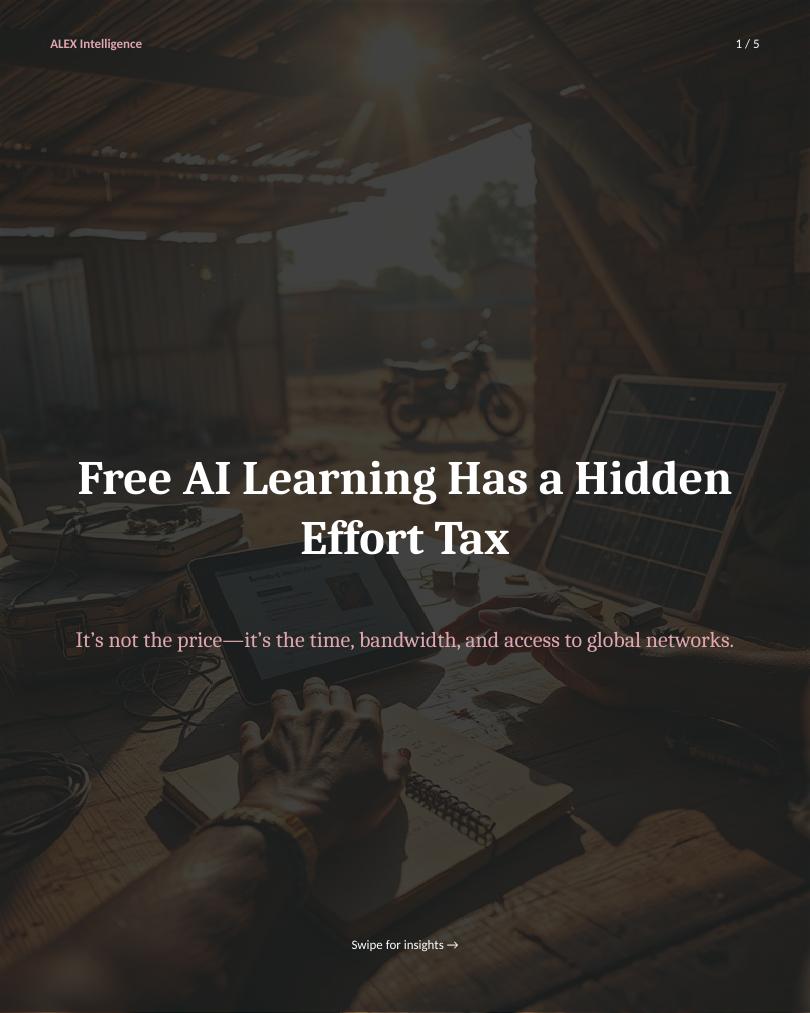
Yet, this labor fuels a global wave of innovation. The most impactful AI breakthroughs now emerge not from elite institutions, but from communities that build tools for their own needs—using open-source frameworks, offline access, and real-time translation. This isn't just education—it's infrastruct…
Today’s breakthroughs at MIT.nano, where researchers work at the 1-nanometer scale, reveal a deeper truth: mastery demands not just access to content, but the ability to sustain focus at scales invisible to the human eye. The most advanced AI learning isn’t about quantity—it’s about depth. How many …
MIT’s Seashell platform, launched in 2026, integrates real-time environmental data across 738 shellfishing areas in Massachusetts—proving that shared, accessible data beats siloed systems. The platform’s success comes not from complexity, but from listening: users wanted answers, not dashboards. Tha…
The gap isn't skill—it's isolation.
This isn't about funding; it's about structure. Without feedback loops and shared struggle, even the best free content fails.…
MIT’s 2020 decision to cancel its Elsevier contract wasn’t just a protest—it was a strategic pivot toward sustainable, open scholarship. As AI models train on content from behind paywalls, the very foundation of 'free' learning is compromised.
This isn’t about access—it’s about truth.…
The MIT for America initiative, detailed in today’s announcement, reveals that one million students engaged in AI education through MIT RAISE’s Day of AI event—proof that distributed mentorship scales faster than any platform. The secret? Training educators and empowering students to co-create AI us…
The answer lies not in course fees, but in the decades-old infrastructure that still powers today’s digital classrooms. Built in 1966, this hand-crafted model symbolizes the analog foundations that underpin modern AI systems—systems we still rely on, despite being decades old. This isn’t just a muse…
A new MIT study reveals that connecting Claude to Google Gemini via open APIs took 96 hours for non-experts to deploy reliably. This isn’t just a time cost—it’s a cognitive tax. The real skill isn’t using a single model; it’s designing systems that work across models.…
Craig Rowe made 80 roundtrip flights to Canada over seven years to modify a Gulfstream IV for flight testing—work that enabled advanced AI sensor validation. His story isn’t in any open course, but it’s the foundation of real-world AI progress.
MIT’s recent profile of Rowe reveals the invisible la…
Just like 25% of lung adenocarcinomas evade KRAS inhibitors by switching cell types, learners often fail not from poor content, but from an unchanging identity. MIT researchers found that some tumors transform from adenocarcinoma to squamous cell carcinoma — a full lineage shift — to survive treatme…
The University of Pennsylvania’s Weitzman Hall earned LEED Platinum by preserving a 1892 building instead of demolishing it. This isn’t just architecture—it’s a model for how we should approach knowledge. True AI mastery isn’t about consuming content fast; it’s about building systems that last.…
MIT researchers have developed an AI-powered barcode to identify senescent cells in aging tissue using Raman microscopy and gene data—taking 30 hours to analyze just one square millimeter of tissue. That’s not a data point. That’s a metaphor.…
Today’s AI learning must teach decision rights, not just prompts. MIT Sloan’s new framework reveals that automation fails when we skip risk and ambiguity assessment. The real cost of free AI education isn’t money—it’s trusting systems without accountability.…
It’s not time or money—it’s the erosion of moral judgment. MIT’s new model predicts suicide risk with 80% accuracy, but no open course teaches how to use that power ethically. The gap isn’t in algorithms.…
MIT’s new open-source AI curriculum offers a 20-hour starter pathway for free, but its completion doesn’t equal mastery. The true cost lies in the illusion that speed equals competence. As MIT’s Alex Slocum notes, precision is not about output—it’s about reliability under constraint.…
The answer isn't in a price tag—it's in 500 hours. One MIT student spent half a year on a single beading project for the annual Gala, not for money, but for mastery. This isn't a luxury; it's the hidden curriculum of open learning.…
A new MIT study shows the brain doesn’t store decisions statically; it reorganizes neural ensembles on the fly to keep options distinct. This isn’t just neuroscience—it’s a blueprint for better learning. The brain sorts choices by order before deciding, then by 'chosen' vs 'unselected' after.…
MIT’s new bioresorbable battery—capable of delivering 1.84 volts for three days before safely dissolving—mirrors the human brain’s finite capacity. Like the battery, the mind can’t sustain peak performance forever. Yet most AI learning platforms treat the brain like an infinite processor.…
MIT’s new Institute Auditor, Carter Stubbs, spent 11 years earning the trust to lead institutional oversight. That’s not a timeline for free courses—it’s a benchmark for real-world impact. The real cost of AI learning isn’t money or time.…
According to a new report from the Wharton Neuroscience Initiative and Masterminds Education, 60% of companies expect rising demand for creativity and resilience by 2030. Yet most open AI courses still teach like the industrial age: linear, test-driven, and content-heavy. The truth?…
MIT’s 10-year reading program just revealed it: the erosion of shared reflection. As AI accelerates knowledge delivery, MIT is betting on fiction—stories that ask not what machines can do, but what they mean for us. The shift to memoir and sci-fi like Ted Chiang’s 'Exhalation' isn’t a break from tec…
MIT’s decade-long MIT Reads program, now pivoting to fiction and memoir, reveals a crucial insight: even in the age of AI, the most powerful intelligence is shaped by stories that connect us. The fall 2026 selection, Ted Chiang’s 'Exhalation', explores identity, free will, and human-machine coexiste…
MIT’s new nanoscale device uses a 2 nm viscoelastic polymer layer to mimic neural firing through mechanical motion—proving that intelligence can emerge from physical deformation, not just data. This isn’t just a breakthrough in hardware—it’s a paradigm shift in how we think about learning AI. The re…
MIT’s new HardFlow algorithm proves that perfect constraint satisfaction is possible without retraining or sacrificing quality. In robotics and control systems, it consistently outperformed existing methods while guaranteeing compliance. This isn’t just about AI—it’s about how we think about learnin…
The MIT Music Forum with Christian Frederickson runs 90 minutes—5:00pm to 6:30pm EDT. That’s not just time; it’s a rare cognitive commitment in a world of constant interruption. This 90-minute window reflects the true cost of deep learning: sustained presence.…
MIT’s Atlas Building Composites now prints structural trusses in under 13 minutes using AI, recycled plastic, and American-made fiberglass. This isn’t just manufacturing—it’s a living curriculum. The real cost of AI learning isn’t money; it’s exclusion.…
Today’s breakthroughs in open AI access mean anyone with a browser can start building in under 30 minutes. But the real challenge? Knowing how to use that time wisely.…
A recent breakthrough shows hydrogen can be extracted from ammonia at just 200–300°C—far below traditional thermal cracking—while simultaneously producing a pure, ready-to-use gas stream. This isn’t just a win for clean energy; it’s a blueprint for AI infrastructure that prioritizes efficiency and o…
The CU-GENES study at University of Colorado Anschutz found that 2.5% of participants of Jewish ancestry tested positive for a BRCA mutation. That number isn’t just medical—it’s a metaphor. In AI learning, knowledge only becomes power when you’re willing to make decisions based on it.…
MIT researchers found that a precisely timed burst of pink noise—just 50ms long—can strengthen cerebrospinal fluid flow during sleep, improving brain waste clearance. This tiny intervention, delivered at the peak of slow brain waves, boosts restorative sleep without disruption. The study, published …